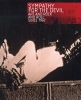
Sympathy for the Devil:
Art and Rock and Roll
Since 1967
by Dominic Molon
2007
Yale University Press
(hardcover; 288 pages)
|
We have been told that John Lennon met Yoko One while viewing her avant-garde art collection in London. And, of course, we watched their art and rock collaborations in the years that followed (even if some of us didn't "get it").
Stories such as these - I remember Basquiat and Madonna in 1980s New York, for one - run through our veins. They play like a film in a velvet, gilded cinematheque through our mind's eye - intrinsic, historical, genetic. These stories are a part of us - veritable DNA.
Thus it comes as no surprise and, indeed, makes total sense that the museum of Contemporary Art in Chicago would assemble an exhibit examining art and rock since 1967 and, as a corollary, that Yale University Press would release a full color hardcover commemorating it.
The book consists of an introduction and essays by Dominic Molon supplemented with essays from other contributors as well as photographs from the art collection itself.
Highlights include personal recollections of "CBGB as a Physical Space" - in a poetic essay by Richard Hill. He explains the graffiti on the club walls: "...it's about a condition, about being young and hungry; about energy, anger, and sex; pure formless assertion. Or not: it's about boredom and frustration." This piece artfuly reflects on youthful angst - so much of the impetus behind rock and graffiti art - and concludes juxtaposed to Justin Kramer photographs of the club's interior.
Also noteworthy, Dan Graham's "Punk as Propaganda" provides useful insights into the Ramones' popularity: "Like Lichtenstein's images, the Ramones' songs are comic-strip stereotypes of American pop culture, the post-Vietnam violence repressed by mainstream pop music's mellowed-out, laid-back, higher consciousness, 'Made in LA' sound. Placed back in the popular culture, their songs become capable of dual (and ironic) readings: the popular or vernacular reading and a second reading that puts into perspective or quotes the first reading."
Moving from the personal experience essay to more analytical work, the collection offers thoughtful reflections into the convergence between art and rock. One frustration readers may have is that the book often features blurry stills from videos featured at the museum. Some may wish that a DVD or a companion websight might have been provided in the age of new media and advanced technologies. Nevertheless, the tome will be a favorite for those interested in art and rock since the late 1960s. Indeed, it is a work of art unto itself.
January 2008
| 







 Film
Film